AFRICAN POWER
— BRIDGING THE GLOBAL AFRICAN DIASPORA FOR A LASTING CHANGE —


The African Diaspora: Why individual success is no longer enough
AFRICAN POWER TALKS
3/16/20263 min read
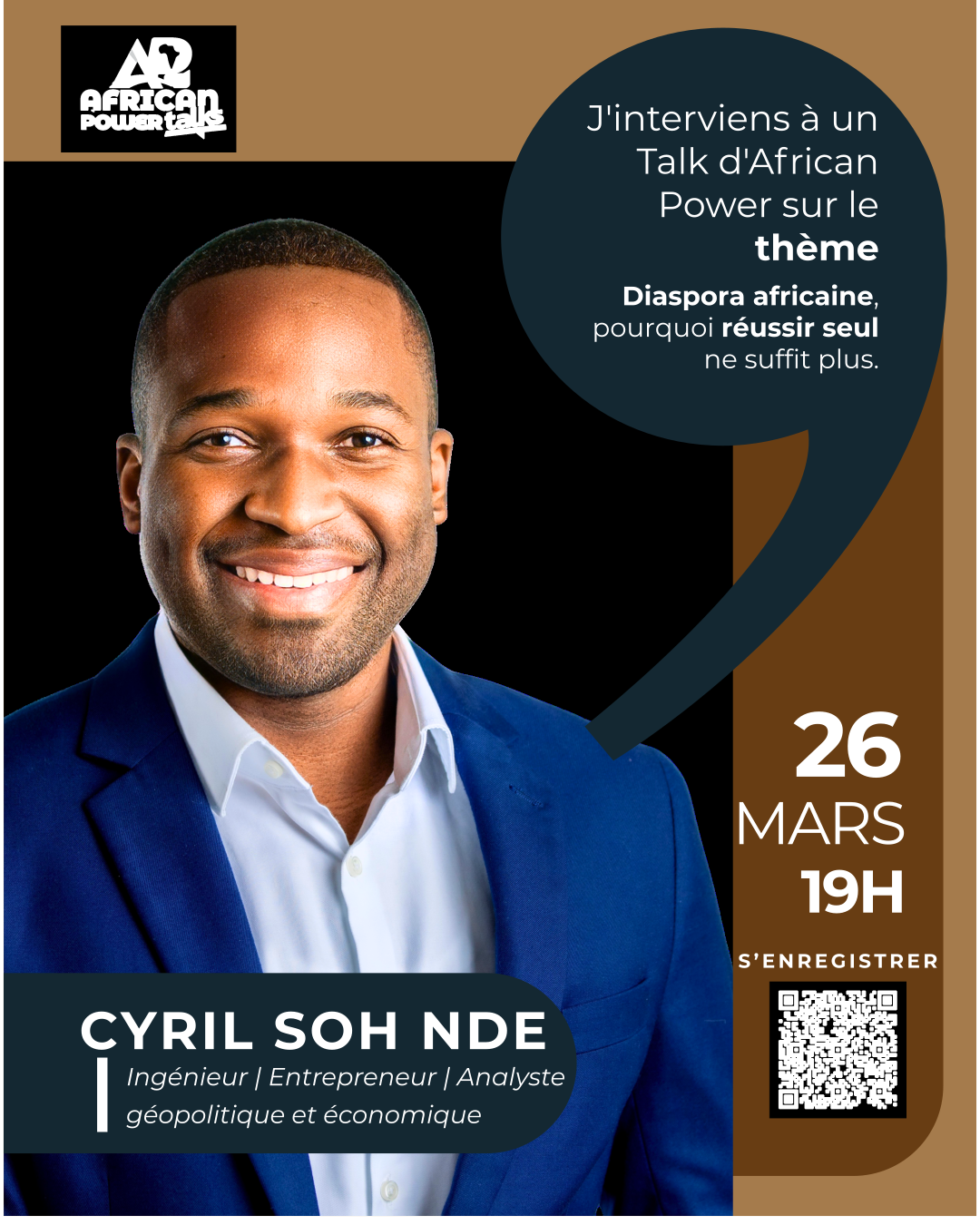
The African Diaspora: Why Individual Success is No Longer Enough
Africa has never seen such a vast concentration of talent beyond its borders.
Engineers, researchers, entrepreneurs, financiers, and senior executives: all over the world, Africans today hold strategic positions within major corporations, international institutions, and leading innovation ecosystems. This global presence represents a historic shift. The African diaspora is no longer just a migratory phenomenon; it has evolved into a global economic and intellectual powerhouse.
Yet, behind this dynamic growth lies a deeper, more challenging question—one we often avoid:
Is the individual success of the diaspora truly enough to transform the economic destiny of the continent?
The Dominant Narrative: The myth of individual success
For decades, the story of the African diaspora has been defined by personal achievement:
Excelling in world-class education.
Joining prestigious multinational firms.
Building distinguished international careers.
Providing financial support to families back home.
This model has allowed millions of Africans to improve their lives and create opportunities for their loved ones. It is a positive reality that must be acknowledged. However, this narrative alone is no longer sufficient to explain or resolve the continent's situation.
Despite the proliferation of brilliant international careers, a stark contradiction persists: Africa remains confronted by major structural challenges. This tension reveals a reality we often ignore: individual success, as admirable as it may be, does not automatically translate into collective transformation.
The Structural Limitation: Fragmentation
The problem is not a lack of talent. African expertise is present in the most advanced sectors of the global economy: technology, finance, industry, research, and strategy.
The true challenge is fragmentation.
Thousands of individual trajectories exist in parallel, yet they are rarely coordinated. Skills circulate, but the mechanisms to organize them remain weak. This fragmentation limits the diaspora’s ability to produce a systemic impact on the continent. In other words, the diaspora excels at individual achievement but has yet to structure its collective power.
The Cost of Fragmentation
In modern economic history, no major transformation has occurred without infrastructure. States, corporations, and economic powers rely on organized systems: institutions, networks, financial frameworks, research centers, and industrial platforms.
In the African context, too many initiatives remain isolated and dispersed.
The talent exists.
The resources exist.
The ambition exists.
However, the mechanisms capable of transforming these elements into structured ecosystems are still insufficient. The cost of this lack of structure is immense. While African talent strengthens foreign economic systems, the construction of sustainable infrastructure for the continent moves at a far slower pace.
The Real Challenge: Organizing Power
The central question is no longer just about "success." It is about organization:
How do we connect African talent scattered across the globe?
How do we transform individual skills into enduring collective mechanisms?
How do we build the infrastructure required for long-term economic transformation?
These questions go far beyond personal career paths. They strike at the heart of the African diaspora’s strategic capacity to envision and build the continent’s future.
Building Pan-African Infrastructure
If the diaspora is to play a structural role in African development, three types of infrastructure are essential:
Human Infrastructure: Capable of connecting talent and structuring professional networks.
Economic Infrastructure: To channel investment, innovation, and value creation.
Intellectual Infrastructure: To produce strategic analysis and visions tailored to African realities.
Without these mechanisms, individual success will continue to thrive, but its collective impact will remain marginal.
A Necessary Conversation
It is within this framework that African Power is organizing a high-level conference:
"The African Diaspora: Why Individual Success is No Longer Enough."
We are honored to welcome Cyril Soh Nde, an engineer, entrepreneur, and renowned analyst known for his lucid insights into the economic and geopolitical dynamics shaping Africa’s future. Through his analyses, followed by thousands, he deciphers power structures, global economic shifts, and strategic opportunities for the continent and its diaspora.
The discussion will explore:
The limits of the "individual success" narrative.
The psychology and contradictions within the diaspora.
The urgent need for collective structuring.
The concrete mechanisms for building sustainable Pan-African infrastructure.
From Success to Responsibility
Participating in this conference is not merely about listening to an analysis. It is about accepting a more demanding question: What are we truly doing with the collective power of the African diaspora?
A diaspora can be a mere sum of individual stories. But when it structures itself, it becomes a historical force capable of transforming a continent’s destiny.
African Power
Structuring, connecting, and empowering African leadership.